
Many prospective buyers who contact me with their requirements often equate flat head screws with countersunk screws. In fact, according to official standards, they are entirely different fasteners. Choosing the wrong one can easily delay lead times or affect installation results. Today, I will walk you through the core differences between countersunk screw vs flat head screw, helping you avoid pitfalls and communicate efficiently in your next procurement!
Similarities Between Countersunk Screw VS Flat Head
- Completely flat top surface: From a top-down perspective, the top surfaces of both are entirely flat, without any curved or dome-like protrusions.
- Highly overlapping drive types: Both flat head and countersunk screws can feature the same drive types. This widely includes the common Phillips and Slotted drives, but Hex Socket and Torx drives are also extensively used in industrial equipment. Therefore, it is impossible to determine their type solely based on the front drive type.
Why Are They Always Confused?
It is precisely because their tops look identical, combined with differences in industry habits across various countries and regions, that these two terms are often mixed up in procurement communications:
- US Standards / North American conventions (ASME / ANSI): In the North American market or on US standard drawings, the industry is accustomed to simply referring to a “Flat Countersunk Head” as a “Flat Head.” If you order a “Flat Head Machine Screw” from a US standard catalog, you will most likely receive a countersunk screw with a tapered profile.
- International and Metric Standards (DIN / ISO): However, in international metric standards and formal mechanical manufacturing drawings, “Flat” and “Countersunk” represent two entirely different bottom physical structures.
Flat Head Screw: The Flat-Bottomed Design
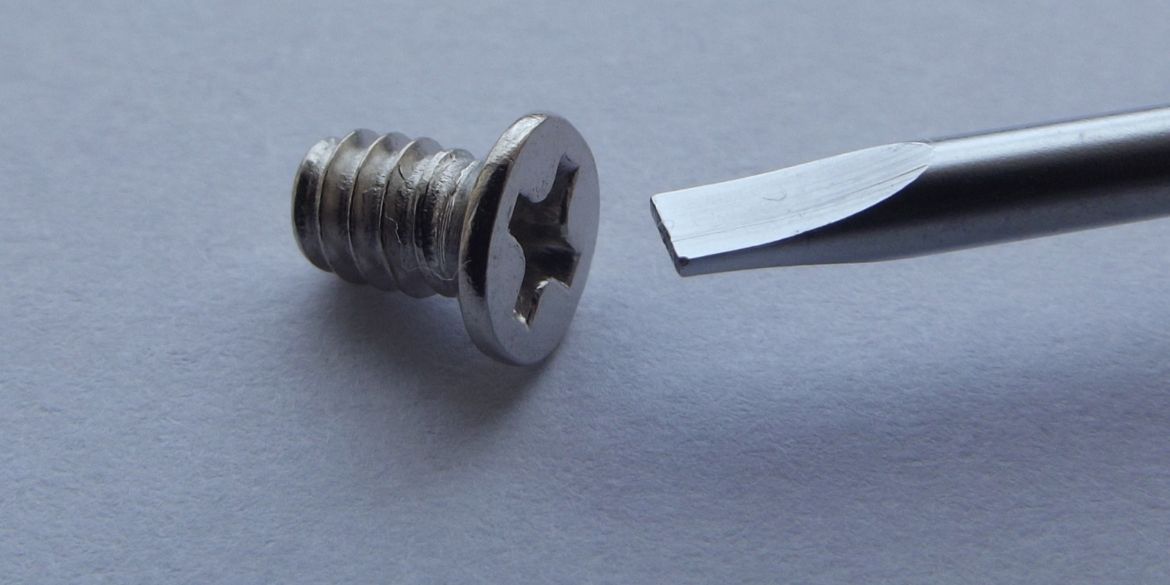
In rigorous mechanical engineering definitions, a true Flat Head Fastener refers to a fastener where both the top and the underside of the head are completely flat. Its bottom has no bevel, curve, or taper.
- Underside structure: The bottom of the screw head forms a perfect 90° right angle with the screw shank (flat-bottomed).
- Installation fit: Because the bottom is flat, once the screw is tightened, the underside of the head rests directly flush against the surface of the connected part, generating a direct downward clamping force.
- Hole requirements: It only requires pre-drilling a standard straight pilot hole, with no need for chamfering or counterboring at the hole opening.
- Typical applications: Connecting thin metal sheets, electrical control cabinet enclosures, areas where the material thickness cannot support chamfering, or assembly scenarios without strict restrictions on the screw head slightly protruding above the surface.
Countersunk Fasteners: The Tapered Cone Profile
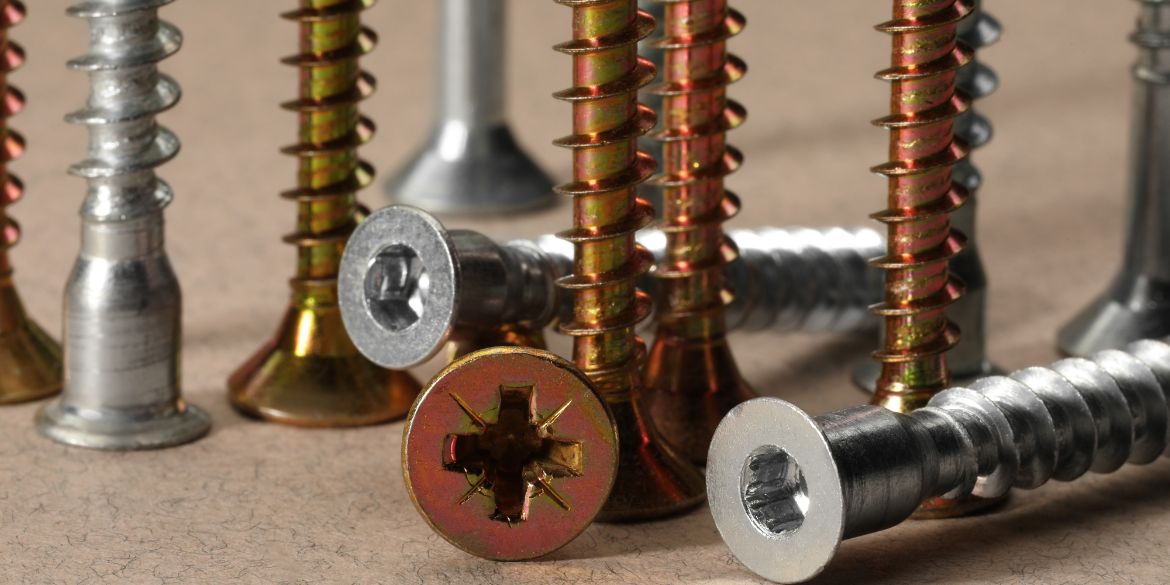
Although a Countersunk Fastener (often abbreviated as CSK in the industry) also features a flat top, its core identifying feature is hidden beneath the head: a funnel-like tapered cone.
- Underside structure: The section beneath the head forms a cone that gradually tapers toward the shank. Depending on different international standards (such as US ANSI/ASME and metric DIN/ISO), common countersink angles are typically 82°, 90°, or 100°.
- Installation fit: The tapered head embeds into a pre-drilled conical countersunk hole on the material’s surface. When fully tightened, the top of the screw can sit 100% flush with, or even slightly below, the surface of the connected material.
- Hole requirements: Before installation, a pilot hole must first be drilled, followed by using a specialized countersink bit to cut a chamfered hole that perfectly matches the screw’s taper angle.
- Typical applications: Mechanical tracks with relative sliding components, aerospace enclosure panels, door and window hinges, high-end furniture, and any tight assembly areas where a protruding screw head is not permitted due to the risk of scratching, jamming, or aesthetic impact.
Countersunk Screw Vs Flat Head: Core Differences
To help you quickly evaluate during procurement and design selection, below is a comparison of the core physical characteristics, mechanical properties, and installation requirements between true flat head screws and countersunk screws:
| Comparison Dimension | True Flat Head Screw | Countersunk Screw (CSK) |
| Underside Structure | Completely flat (underside forms a 90° right angle with the shank) | Tapered cone profile (common angles are 82°, 90°, or 100°) |
| Load Bearing & Mechanical Strength | Relatively lower (the right angle between head and shank leads to high stress concentration, resulting in weaker tensile and impact strength) | Relatively higher (the tapered transition structure distributes stress more evenly, withstanding higher tensile and shear forces) |
| Post-Installation Surface Effect | The entire screw head protrudes above the material surface | The screw head is 100% entirely flush with the material surface |
| Installation Difficulty | Lower: Only requires drilling a standard straight hole; no secondary chamfering needed. | Higher: Requires drilling a tapered chamfered hole; alternatively, it can be paired with a specialized countersunk washer. |
| Material Thickness Requirements | Broad applicability; thin metal or wood sheets can be used. | The connected material must be thick enough to accommodate the depth of the tapered chamfer. |
| Force Distribution Characteristics | Force is concentrated on the flat underside, providing direct vertical clamping force. | Force is distributed across the tapered slope, providing a certain self-centering effect. |
| Core Advantages | Simple processing, no special tools required, fewer restrictions on material thickness. | Higher structural strength, smooth surface with no interference, neat visual appearance. |
Project Selection Guide: Which Head Type Do You Need?
Scenarios prioritizing Countersunk Screws:
- Surfaces with relative movement or strict flatness requirements: Assembly areas where sliders pass by, tracks operate, or on door/window hinges and chassis enclosure panels. Any protrusion would cause jamming, friction, or safety hazards.
- Bearing higher tensile and shear forces: Used in heavy-duty structural components subject to significant loads, seismic requirements, or high-strength connections. The tapered neck of the countersunk screw effectively disperses stress, providing greater structural safety.
- Sufficient connection material thickness: The connected materials (e.g., thicker metal plates, wooden boards, or plastic parts) have enough depth to cut a matching tapered chamfer hole.
- Pursuing an exquisite appearance or pairing with decorative washers: Used in high-end furniture, instrument enclosures, or combined with specialized countersunk washers (finishing washers) on softer/thinner materials. This achieves a refined and elegant assembly effect without the need for chamfering.
Summary
Identifying the underside structure is the key to precise selection: flat-bottomed screws are suitable for thin sheets and simplify the process, while countersunk screws achieve a flush surface and higher strength. As a professional fastener manufacturer, we provide metric and US standard components as well as non-standard customization. If you have any questions regarding product selection or require bulk procurement, feel free to contact us anytime for professional advice and fast quotes!


 English
 Spanish
 Arabic
 Russian
 Portuguese