
Washers look simple, but they play a critical role in bolted joint integrity. Selecting the right type prevents connection failures and maintains bolt preload. In industrial procurement and mechanical assembly, four core types handle the vast majority of applications:
- Plain / Flat Washers
- Spring Washers
- Lock Washers
- Structural & Specialty Washers
Plain / Flat Washers
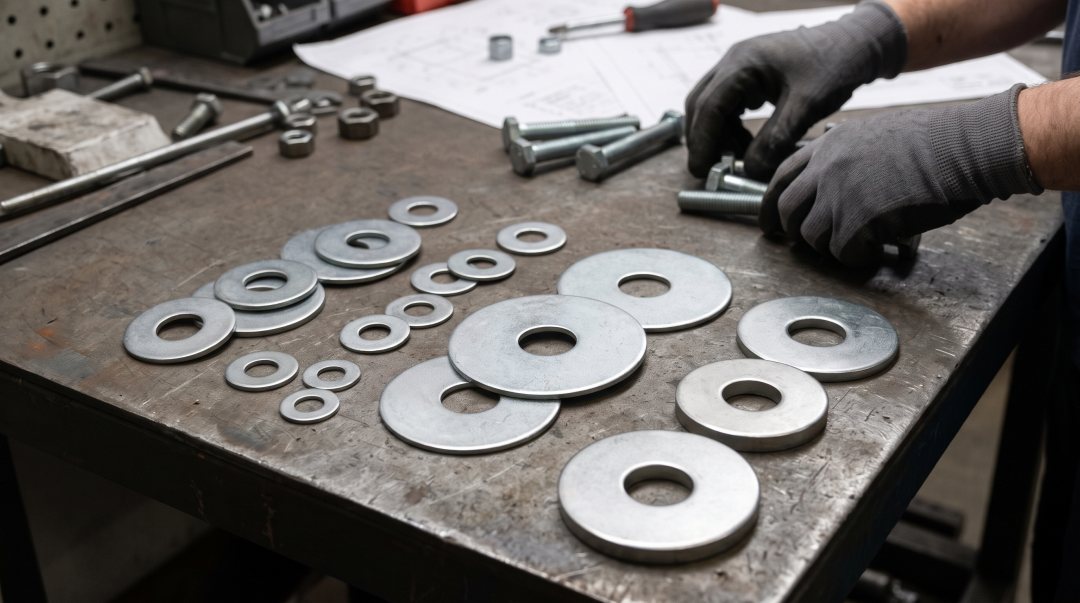
Flat washers are flat stamped discs with a central hole designed to clear the bolt shank. Their main job is spreading the clamping load over a larger surface area. This reduces contact pressure against the base material, stops bolt heads or nuts from crushing soft surfaces, and spans oversized clearance holes.
- Standard Flat Washers (DIN 125A / ISO 7089): Match standard clearance dimensions and handle everyday mechanical assemblies and structural connections.
- Fender Washers (DIN 9021): Feature an outside diameter roughly three times the inside diameter. The large surface area distributes load across sheet metal, aluminum, plastics, and wood, preventing edge tear-out and pull-through.
- Heavy-Duty Flat Washers (DIN 7349): Use thicker cross-sections to match high-tensile hex bolts or socket head cap screws, resisting dishing or cupping under high tightening torque.
Spring Washers
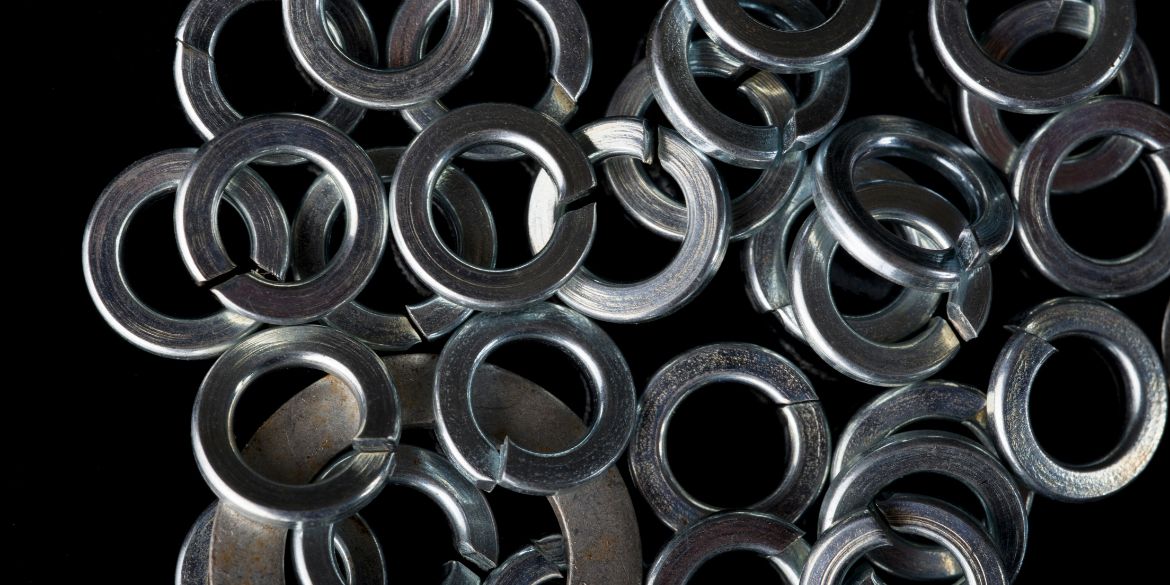
Manufacturers typically form spring washers from 65Mn spring steel or hardened stainless steel. These washers store mechanical energy and compensate for joint settling. As tightening compresses the washer, it exerts continuous axial force against the fastener face, offsetting tension losses caused by vibration, thermal cycling, or gasket creep.
- Split / Helical Spring Washers (DIN 127B): Feature a cut split with offset ends. Compressing the split provides constant spring reaction for low-to-medium strength fasteners.
- Wave Washers (DIN 137B): Feature curved waves around the circumference that provide smooth, moderate spring travel. They eliminate axial play in electric motor bearings and work well in compact mechanical enclosures.
- Belleville / Conical Spring Washers (DIN 6796): Feature a conical disc profile capable of handling high loads with minimal deflection. They maintain tension on Class 8.8 and higher bolts in high-pressure pipe flanges and thermal cycle systems.
Lock Washers
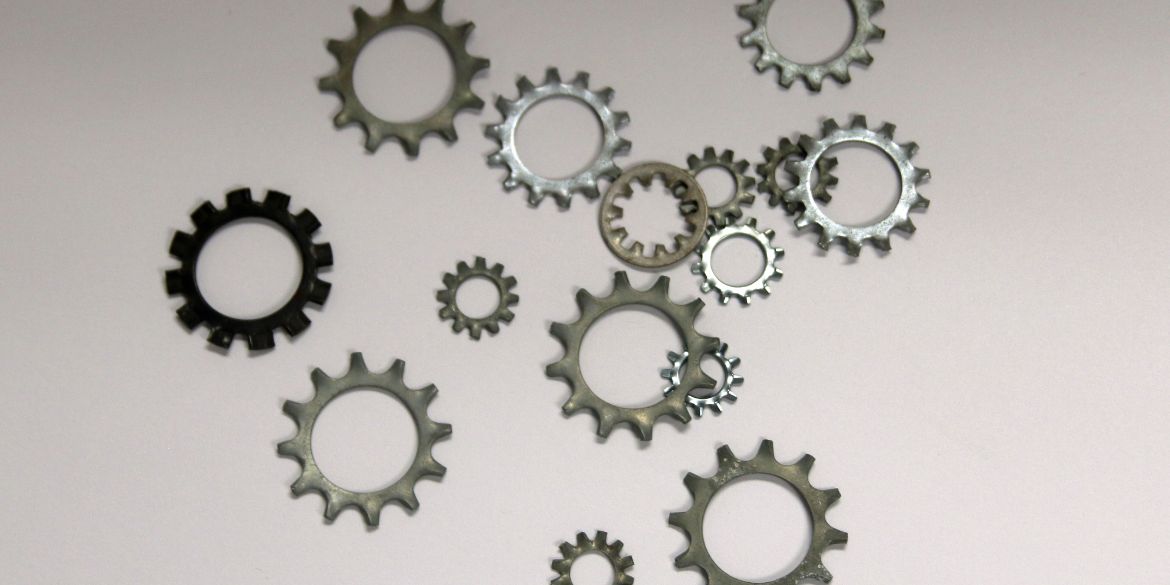
Lock washers target dynamic loads, heavy impact, and alternating vibration. Instead of relying solely on spring elasticity, they use sharp teeth that bite directly into mating surfaces or utilize paired ramp profiles that physically stop the fastener from unthreading.
- Arruela de pressão externa (DIN 6798A): Features outward-facing teeth that bite into the outer rim of the bolt head, maximizing torsional resistance. The teeth also cut through surface coatings and paint to establish electrical grounding.
- Internal Tooth Lock Washers (DIN 6798J): Direct their teeth inward around the bore, leaving a smooth outer rim that will not scratch visible panels or catch on adjacent components. They fit small pan-head and round-head machine screws.
- Wedge-Lock Washers: Run in glued pairs. The outer faces grip the bolt head and joint surface with radial teeth, while the inner faces interlock with cam ramps. Because the cam angle exceeds the bolt thread pitch, any loosening movement wedges the washer pair open, increasing clamping tension and locking the fastener. They suit rail transit, mining machinery, and wind turbine towers.
Structural & Specialty Washers
Specialty washers solve specific geometry problems, such as non-parallel surfaces, sloped flanges, high-strength structural clamping, and fluid sealing.
- Square Taper Washers: Feature an 8% slope for I-beams (DIN 434) or a 14% slope for channel sections (DIN 435). They sit under the nut to square the seating surface, ensuring the bolt remains in pure axial tension without bending or shearing.
- Structural Washers (ASTM F436 / EN 14399-6): Use quenched-and-tempered medium carbon steel heat-treated to 38–45 HRC. They support the heavy preloads required by ASTM A325, A490, and Class 10.9 structural bolts without galling or yielding.
- Bonded Sealing Washers: Vulcanize a weather-resistant EPDM rubber seal to a metal backing. Used with self-drilling and self-tapping screws, they form a waterproof seal on metal roofing, siding, and outdoor enclosures.
- Countersunk / Finishing Washers: Feature a cupped profile that supports 90° countersunk screws on thin sheet metal without requiring a countersunk hole, covering rough hole edges and giving an even finish.
Engineering Selection Guide
| Assembly Condition & Risk | Recommended Category | Specific Standard / Style | Avoid Using |
| Thin sheet metal, plastics, or soft wood prone to crushing | Plain / Flat | Fender Washer (DIN 9021) | Standard flat washer (DIN 125, small OD concentrates stress) |
| High-strength steel structure under high torque (A325 / 10.9) | Structural | Quenched Structural Washer (ASTM F436 / EN 14399-6) | Soft low-carbon flat washer (cups and deforms) |
| Motor mounts and steam/gas flanges subject to thermal cycles | Spring | Belleville Conical Washer (DIN 6796) | Standard flat washer (provides zero axial compensation) |
| Mining machinery, crushers, and severe vibration | Lock | Wedge-Lock Washer Pair | Standard split lock washer (flattens out under high load) |
| Flange inner slopes on I-beams or U-channels | Specialty / Structural | Square Taper Washer (DIN 434 / DIN 435) | Standard flat washer (bends the bolt shaft) |
| Outdoor metal roofing and siding weather seals | Specialty / Structural | EPDM Bonded Sealing Washer | Solid metal washer (allows water leakage) |
Material & Hardness Matching
Match washer hardness and material to the bolt grade and base metal to avoid galvanic corrosion and joint yield:
- Carbon Steel Hardness Rules
- Class 4.8 / 6.8 Commercial Bolts: Pair with unhardened Q235 or Q195 cold-stamped flat washers (100–140 HV).
- Class 8.8 High-Tensile Bolts: Require normalized or quenched-and-tempered 45# carbon steel washers rated at 200 HV minimum.
- Class 10.9 / 12.9 Heavy-Duty Bolts: Never use soft low-carbon washers. Specify 300 HV high-carbon manganese steel (such as 65Mn) or quenched-and-tempered 40Cr steel (such as ASTM F436) to prevent the washer from crushing under proof load.
- Stainless Steel Selection
- SS304 (A2-70): Fits general outdoor construction, municipal water treatment, and food-processing equipment.
- SS316 (A4-80): Contains 2–3% molybdenum to resist pitting corrosion in marine salt spray, coastal installations, and acidic chemical processing. Pair SS316 bolts exclusively with SS316 washers.
- Avoid pairing zinc-plated carbon steel washers with stainless steel fasteners in damp environments, as the galvanic potential difference will corrode the zinc and steel.
- Surface Finishes
- Clear / Blue Zinc Plating: Offers 5–8 μm coating thickness with 24–72 hours of salt spray resistance. Fits dry indoor equipment.
- Hot-Dip Galvanizing (HDG): Provides 45–65 μm minimum coating thickness with high abrasion resistance. Standard for utility towers, solar racking, and highway guardrails.
- Zinc Flake / Dacromet / Geomet: Delivers uniform, thin coverage with zero risk of hydrogen embrittlement and over 1,000 hours of salt spray protection. Standard for automotive chassis components and wind turbine hardware.
Resumo
Selecting the right washer type, hardness grade, and protective coating keeps joints tight, stops vibration loosening, and prevents surface crushing, cutting downstream repair costs.
We maintain comprehensive inventories of standard DIN and ASME washers and manufacture custom stampings to your print. Send us your bill of materials, project drawings, or operating specifications, and our engineering team will deliver matching technical solutions and factory-direct pricing within 24 hours.



 Portuguese
 English
 Spanish
 Arabic
 Russian