As a seasoned professional in the fastener industry, I often encounter clients and mechanical enthusiasts asking me: Perno de carruaje vs hex bolt appear to have identical threads—does choosing one over the other really make a difference?
If you’re struggling with a procurement list, this article is for you. I will guide you through a comprehensive understanding of carriage bolts and hex bolts, covering structural design, diverse models, and practical applications.’
Although their threaded sections are completely interchangeable in terms of specifications, the design logic of their heads is fundamentally different.
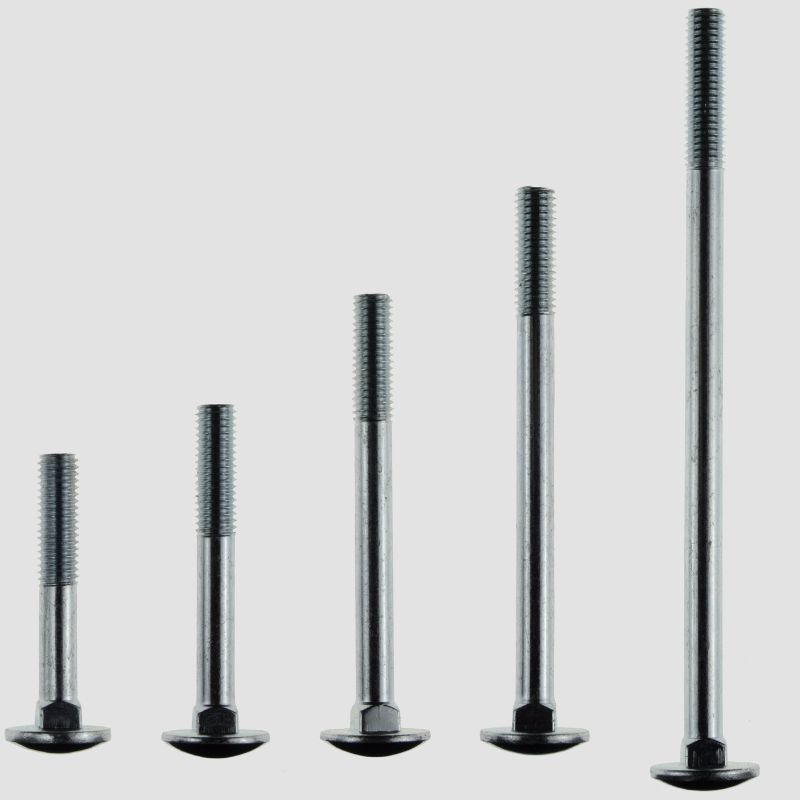
The head of a carriage bolt features a smooth, elliptical curved surface, resembling a plump mushroom; what truly sets it apart is the square neck structure immediately below the head at the top of the threaded shank—a distinctive characteristic that distinguishes it from any other type of bolt.
In contrast, the perno hexagonal is angular and defined, with a head composed of six precisely formed equilateral sides, giving it a more robust and solid overall profile, and its lower end connects to a meticulously crafted threaded shank.
Different types
Pernos de carruaje
In addition to the classic DIN 603 square neck, there are also countersunk square neck types for a flush surface, round head fin neck types to prevent slippage in soft materials, and ribbed neck types for enhanced grip; even in heavy-duty equipment, hexagonal head carriage bolts can be found, which combine hex drive with square neck self-locking.
Pernos hexagonales
Based on DIN 933 full thread and DIN 931 partial thread, variants have been developed, including flange head types with built-in pressure distribution, dual-drive (cross/slot) types compatible with various tools, and hollow types for oil passages or weight reduction; for high-vibration environments, there are even special specifications with drilled heads or shanks to accommodate safety wires or cotter pins.
Differences in Installation Methods
Carriage bolts first embed the square neck into the base material, then install the workpiece and nut from the other end; installation can be done from one side, and the head does not require an additional wrench for fixation.
Hex bolts require fixation at both ends: the head must be held in place with a tool to prevent the bolt from rotating before tightening the tuerca.
Disassembly and Maintenance
Carriage Bolts:
Maintenance is relatively difficult. If the bolt rusts and causes the internal square hole to wear out, the bolt will spin freely along with the nut. Since the head cannot be secured with tools, such situations often require the use of cutting tools for destructive removal.
Hex Bolts:
Maintenance is extremely convenient. As both ends provide points of force application, even if the bolt is rusted, two people can use tools from both ends to cooperate in removal, ensuring no disassembly pressure even in highly corrosive environments.
Safety Comparison
The exposed head of a carriage bolt is rounded and smooth, making it less prone to impact and scratching. Additionally, it serves as an anti-theft feature, as it cannot be removed from the head side.
A hex bolt can be removed with an adjustable wrench, a tool found in almost every household, but its sharp edges are more susceptible to impact in high-traffic environments.
Strength Difference
Since the fastening of carriage bolts relies on the friction between the square neck and the wall of the hole of the workpiece, their overall load-bearing strength is generally lower than that of hex bolts.
Especially under long-term vibration or high-pressure environments, if the square hole wears out and causes “slippage,” the bolt will rotate along with the nut, making disassembly extremely difficult and often requiring the use of cutting tools.
In contrast, hex bolts are designed for high torque. When used with wrenches or power tools, they can withstand significant mechanical fastening preload forces and are available in various high-strength grades such as 8.8, 10.9, and even 12.9.
Whether in heavy machinery or precise steel structure connections, they provide extremely stable and controllable support.
Selection Scenario Matching Chart
Application Scenario
Recommendation type
Large wooden structure
Carriage bolts, with their square necks embedding into wood for automatic locking, enable efficient one-sided installation; they are perfectly suited for composite connections such as wood-to-wood, wood-to-metal, or wood-to-plastic.
Heavy machinery
Hex bolts, supporting high-grade torque pre-tightening, offer excellent shear resistance; with multiple force-bearing points on the head, they significantly enhance the convenience of later maintenance.
Anti-theft scenario
The carriage bolt features a semi-round head with no external points for applying force, making it impossible to remove with conventional tools, thus possessing inherent anti-prying properties.
Marine Decking
The smooth head of a carriage bolt prevents water accumulation and salt retention, effectively delaying the aging and corrosion of fasteners.
Furniture Decoration
Carriage bolts feature a retro aesthetic in their heads, often serving as decorative fasteners in solid wood furniture assembly to enhance visual quality.
Steel structure building
Hex bolts, featuring an extensive range of specifications and strong adaptability, support precise force measurement with torque wrenches, ensuring the structural safety of large frameworks.
Pipe flange
Hex bolts or double-ended studs generate powerful axial clamping force through uniform multi-point fastening, ensuring zero-leakage sealing in high-pressure environments.
Pitfall Avoidance Guide
Selection by Environment:
For outdoor gardening or coastal construction, even if the carriage bolt structure is suitable, if the wrong stainless steel (A2/A4) or hot-dip galvanized material is chosen, the fastener will corrode soon.
Hole Accuracy:
When purchasing carriage bolts, be sure to confirm the square hole size on the workpiece. If the square hole is larger than the bolt neck, it will lose its self-locking function, causing the bolt to spin in the hole, requiring electric welding to secure it.
Grade Mislabeling:
Many low-priced hex bolts often ‘shrink’ in strength grade. For critical load-bearing parts, always request material certificates and strength grade reports from suppliers. In mechanical connections, the load-bearing capacity difference between grade 4.8 and grade 8.8 is too significant; never compromise safety to save costs.
Resumen
Based on the above comparison, you likely have a new answer for choosing between carriage bolts and hex bolts. In simple terms, if you prioritize safety, aesthetics, and convenient one-person operation, carriage bolts are the preferred choice; if you require maximum strength and frequent maintenance, hex bolts are your best option.
At T&Y, we deeply understand that every small component carries the safety of the entire project. Whether you are seeking high-quality carriage bolts compliant with DIN 603 standards or require hex structural connectors with grade 10.9 or higher strength, we can provide you with precise specification support and reliable quality assurance.





 Spanish
 English
 Arabic
 Russian
 Portuguese